Tony Leung
The incredibly famous actor lives a life of endearing simplicity
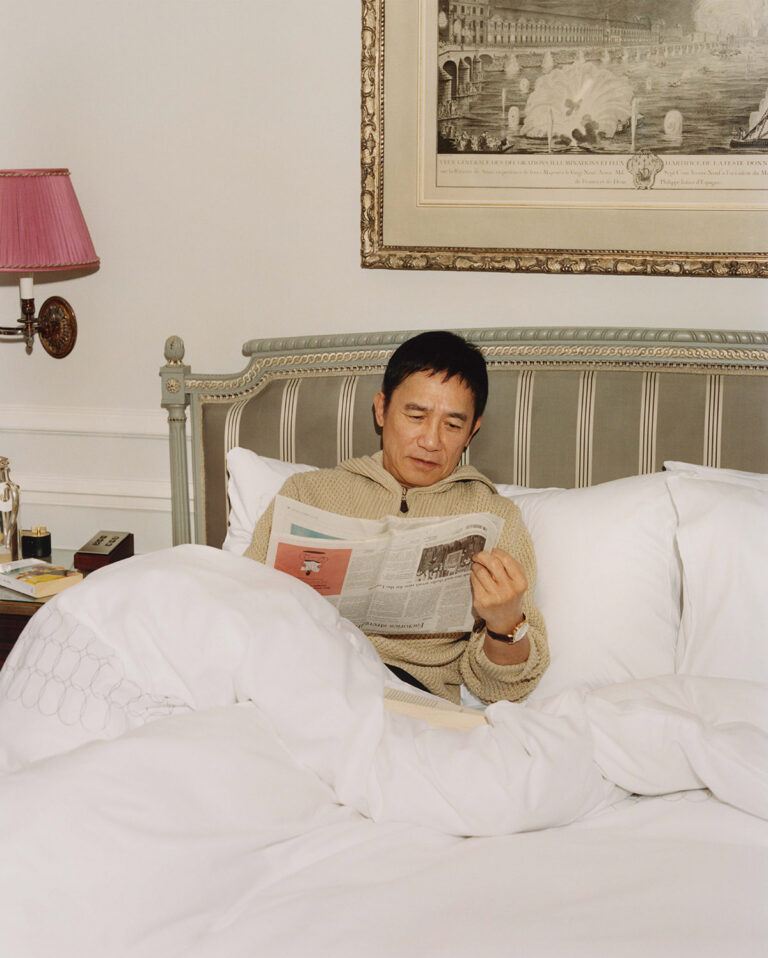
Tony Leung arrives without ceremony. He stands quietly by the door, not yet announcing himself. It doesn’t feel shy, or awkward even, so much as considerate. An instinct not to take up space before it’s offered. Or perhaps a wariness of the inevitable: the room adjusting itself around him.
From Fantastic Man n° 42 – 2026
Text by HYNAM KENDALL
Photography by ANDREW JACOBS
Styling by JASON RIDER
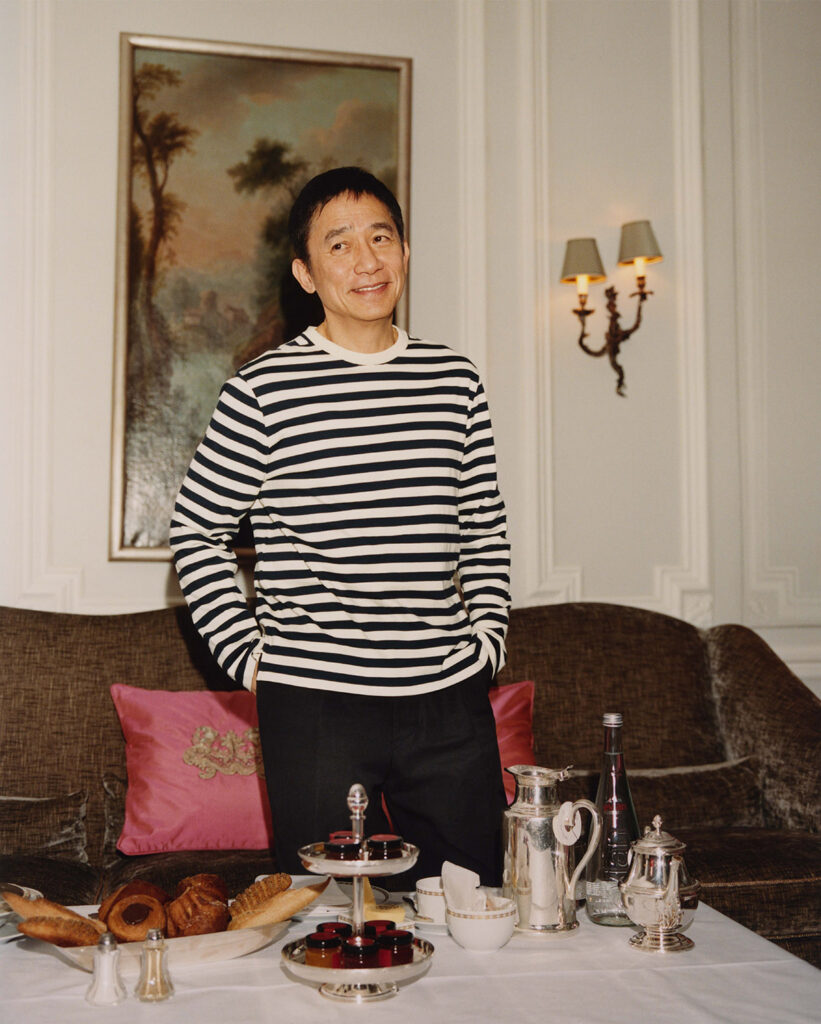
The Haute Couture Suite at the Plaza Athénée is filled with decadent stillness. A trolley set out with what looks like lunch: small mountains of fruit, robust pastries, egg-yolk glazed to a careful shine – the fa¬miliar architecture of hotel dining. Heavy curtains. Thick rugs. Glass chandeliers dropping light in careful increments. The room feels prepared. Waiting.
When his presence is finally noticed, the room does, in fact, recalibrate. Not self-consciously, but unmistakably. After insisting it doesn’t matter where he sits (“I’m happy anywhere.” “Whatever you want.”) he takes to a large brown sofa at the centre, flanked by gilt oil paintings and ornate sconces. Coffee waits on a low table in silver pots. Outside, Avenue Montaigne moves quickly and brightly, oblivious. For 40 years, Leung has been entering rooms like this that already know who he is.
He first started on Hong Kong television in the early 1980s, emerging from TVB’s training system at the point when Hong Kong was producing stars the way other places produced office workers: quickly, visibly, at scale. This is where the discipline comes from.
By the 1990s, as Hong Kong cinema sharpened and travelled, he became one of its most precise instruments. His filmography is unusually hard to reduce because it refuses a single signature role – or archetype. But it is Wong Kar-wai’s films – the ones people return to compulsively – that turned Leung into something close to a global reference.
In ‘Chungking Express’ (a personal favourite of mine), he plays Cop 663, recently abandoned, speaking to a bar of soap and a dishcloth as if they might offer reply. The camera drifts through cramped interiors; time stretches; ‘California Dreamin’’ repeats ad infinitum. Longing becomes procedural. The movie’s neon-drenched night scenes and moody, dreamlike portrayal of urban loneliness launched a thousand Tumblrs in its time.
Then there’s ‘Happy Together’. Two men from Hong Kong land in Buenos Aires in an attempt to start over but instead replay the same rupture in different rooms. They break up, reunite, split again. What endures is the exhaustion. When Wong won Best Director for this film at Cannes in 1997, it marked an inflection point for queer cinema on the international festival circuit – because it refused to sentimentalise the relationship.
And then ‘In the Mood for Love’. Two neighbours realise their spouses are having an
affair. Instead of confronting them, they begin reconstructing it – rehearsing lines, replaying imagined scenes, trying to locate the exact moment it started. They share noodles, pass in stairwells, stand too close in corridors. The drama lives in deferral: what’s withheld becomes the plot. Leung won Best Actor at Cannes in 2000 for his role in the film, becoming the first Hong Kong actor to receive the award. His performance has since become shorthand for cinematic restraint.
He is, plainly, one of the most significant screen actors of the past four decades. And that standing was secured long before any association with Hollywood. For many years, his films travelled the world without him needing to. In fact, until relatively recently, he had never worked within the machinery of a major American studio. His first Hollywood production came only in 2021, with Marvel’s ‘Shang-Chi and the Legend of the Ten Rings’. Now, with Hungarian director Ildikó Enyedi’s ‘Silent Friend’, he appears in his first film made in Europe. These are not turning points so much as expansions – a widening of geography at a tempo he controls.
And yet, if you didn’t know the pedigree, you might miss it. Not because Leung’s presence feels small – it doesn’t – but because his authority arrives quietly. He has been travelling for a week, he says. This – Paris – is his seventh stop. The premiere of ‘Silent Friend’ was last night at the Pathé Palace: a restrained, off-centre drama about intimacy, isolation and attention, in which Leung plays a neuroscientist whose work – and private life – is shaped by a sensitivity to how living things communicate beyond words.
Earlier today there was a Dior fitting – his first. Later tonight, a public “masterclass”: a formal seminar in which he will unpack a long and storied career which he would prefer not to frame in such grandiose terms. Such is his aversion to the word “master.” It suggests a kind of completion, you see. Tomorrow he will attend the Dior show in the gardens of the Musée Rodin alongside his wife, Carina Lau Kar-ling. Madrid and Rome are still to come. The schedule is tight, continuous. But Leung does not rush.
Throughout our time, he speaks measuredly. Calm. He pauses often. Takes time before answering, even when the question is simple. His answers are careful – not evasive but quite literally filled with care. Sometimes the answer is a single word. But what matters, you sense, is not the statement itself, but the condition in which it arrives.
HYNAM – When you wake up in Paris, what do you do to ensure it’s going to be a good day?
TONY – Going to a museum. Always my favourite thing to do here.
Any particular one?
The Louvre. Mainly. Over the years, somehow, I have managed to collect a number of friends here – people based in Paris – like Ágnes Hranitzky. She is an editor and a director who worked for a long time with Béla Tarr. Whenever I’m here, she takes me to very small galleries. I never know the names.
Has there been a recent exhibition that stayed with you?
Last year there was an Impressionist exhibition at the Musée d’Orsay. Very big. Very vibrant. Full of life. That impressed me a lot.
What is it about Impressionism that you respond to?
I just feel it. When I look at it, I can feel it. I don’t know how to explain it. I’m not good at explaining.
When you’re here, where do you go to eat without even thinking?
The 13th arrondissement for Vietnamese. There’s one place I usually end up: Phở Tái. And my order is, of course, pho. I realise I just follow noodles – Vietnamese, Japanese, Chinese. If there’s a bowl in front of me, I feel settled.
There’s a comfort in continuity.
Yes, there is.
You’re in premiere mode right now. What has the last week looked like for you?
Car, train, plane. Up very early. Very long days. A lot of talking. Talking, talking. But I want to share my experience. I want to see and meet the audience. So, I must do it.
Do you enjoy the promotional period?
No, not really. [A beat] And yes.
No and yes?
Something that is very nice is that I see a lot of Asian people in the audiences when I do this. I seldom see that happen normally. To make work that reaches them, and to see people travelling from around the world to see these films – that means something to me.
What’s the least glamorous part of all this?
Glamour? What glamour?
Red carpets, champagne receptions, fancy outfits. On the surface, it always seems very glamorous.
Well, I don’t have a make-up artist. I don’t have a hairdresser.
Really? Because your hair looks great.
Thank you! But really, I just do it myself. I’m being natural. This is me.
Is there a version of you that people expect to meet?
Yes. They expect me to be very quiet. Very shy. Someone who likes to be alone.
And is that true?
Yes. If I don’t know you.
But you’re not being shy with me.
Interviews are not so bad because there are set topics. You know what you’re here to talk about. That makes it easier. But when I’m in front of a lot of people, I feel less settled. Uneasy. And right now, that’s difficult, because I’m doing a lot of talks, a lot of Q&As. You just pretend they’re not there. I don’t know, you do it anyway. Because you must do it.
You’ve been described as a sex symbol. When did you first become aware of that?
It’s because of Wong Kar-wai. Most of his films are about love affairs. Romantic. Filled with love. ‘In the Mood for Love’ – that’s when it started. Also, ‘Happy Together’. People really responded to that film. That’s when they began to say I had some kind of sex appeal.
Were you surprised at being a sex symbol?
No. [Laughs]
It must be a heavy burden.
[Laughs again] The sex appeal is in the movie. It’s Wong Kar-wai’s sex appeal, really. It belongs to him.
You travel endlessly. Do you pack the same things – and the same way – every time?
Yes. And I pack everything myself. Very proudly.
So, you’re a good packer?
I’m very good. I fit a lot. It’s impressive.
Are you superstitious? Do you pack any good-luck charms?
No. I’m very practical minded.
Are there objects you like having around you when you’re working? Personal objects, artefacts to remind you of home, to keep you grounded?
No.
No on-set rituals?
No habits. But I always bring medicine. All the medicine. I worry something will happen and I won’t have what I need. That would make me feel very insecure. It’s every time I travel – personal travel, now, travelling with promotion. Even when shooting. If someone on set has a problem, I usually have something for that.
So you’re the on-set doctor?
Yes. A little pharmacy.
How did ‘Silent Friend’ come to you?
Ildikó Enyedi wrote a character for me without knowing me. One day I was working with William Chang – my best friend, the art director and costume designer on all of Wong Kar-wai’s films – and he told me she was looking for me. I asked, “Who is Ildikó?” He said, “She’s a very good director.” I watched ‘On Body and Soul’ first. I was very moved. The sensation of it. The connection between people. Then ‘The Story of My Wife’. And I thought, “I want to work with this director.”
So you said yes?
I read the script, and we had a Zoom meeting. After that first meeting, I decided straight away. I need to feel the person I’m going to work with. I trust my instinct. I trusted her.
When you receive a script, do you read it straight away?
Always.
I’m getting the impression there’s no routine to it. No specific time of day, or place?
No. Not only in the daytime, or the night. I read everywhere. Anywhere. Any time. Always all the way through.
So, reading, like packing, is logistics rather than ritual?
I think so.
Do you like to be challenged?
Yes.
How did this role challenge you?
It was interesting to me because I had never played someone like this person: a neuroscientist. I’m not a science person. So, I had to study a lot. To learn a lot.
You’re known for a kind of stillness in your acting. Letting moments sit, not rushing to respond. Taking your time. Is that something you’re conscious of when you’re working?
No, not really. I spent six months convincing myself I am a neuroscientist. Slowly, I get into the character. Those moments belong to him. It’s not a choice. When I’m filming, I just try to feel.
In ‘Silent Friend’, you play someone whose work depends on understanding how living things communicate through systems rather than speech. Preparing for that meant a lot of research about trees and plant networks. Did that change the way you look at them?
Completely. The way I look at a tree now is different, because I understand how it works. Trees are incredible. They communicate with each other. Through roots. Through fungus. They warn each other about danger.
There’s a book – ‘The Hidden Life of Trees’ – that says trees can even recognise their own kin. They can tell their offspring from the other trees. It really expresses that trees are social…beings? Is that the right word?
You know, I go jogging out in nature, and recently I was jogging on top of a mountain, and I had a very strange feeling. I felt like the trees were watching me. And I also felt in that moment that we are the same. They are very much like human beings, I think. But they grow at a much slower pace. And I believe the trees that are one hundred years old, two hundred years old, that they too have a soul. In a way. In traditional Chinese philosophy, we believe that.
Has this experience changed you in any practical way?
Last year I built a house near a lake and I told the contractor: do not kill any trees. None. And so my garden is full – any different trees and plants. I know all the names of the types. The smells. They all have different fragrances. I know them individually.
People like to project a lot onto plants – talking to them, for example. Having conversations with them.
I know some people like to play music to their plants. Apparently, it helps them to grow, I don’t know why. I don’t know the science. But I don’t talk to mine.
So no unusual behaviours between you and your plants?
In Buddhism, we hug trees. Like this. [Extends his arms to form a full circle in front of himself]
What does that do?
It cleans your…I don’t know. Your body.
You don’t name your plants or trees?
No. That’s too far!
Looking back over your 40 years in industry, is there something you’ve stopped doing as an actor?
Yes. My turning point was on ‘A City of Sadness’, where I worked with many non-professional actors. They were so natural. Very restrained, observational. My acting instincts, which were more expressive compared to theirs, felt excessive. I realised I was overacting.
You definitely don’t overact.
Yes, I did overact. I saw them just “being.” It was real. I wanted to act like them, but still with technique. To be like them, but with the knowledge I had about the craft. After that film, I really tried to tone down my acting. That was one of the big things I learned in my career.(6)
What still feels difficult?
Action.
Action?
The physical nature of it, yes. At this age, that’s very difficult. Everything else is not difficult, you just need time. Practice. But the physical side is demanding.
But if a new superhero movie came along and wanted you to fly and scale buildings…
Well… They have stuntmen! They have body doubles! So that’s fine.
Do you ever get things wrong?
Always. I always consider myself a beginner on every film. I’m never satisfied. I always want to be better.
Even now?
Even now.
But you’re one of the greats.
I never think I’m good. I don’t see myself like that.
Are you striving for a moment where you watch yourself back and think, “Yes! that’s it, that’s what I was going for!”?
Yes.
Do you think that moment exists?
I hope so. That’s what keeps me going. You could argue that, on one hand, always striving to be better every time keeps you from becoming complacent. But on the other hand, it’s very stressful. Especially on set. There was a scene in a lecture hall in ‘Silent Friend’. Ildikó wanted to do a master shot – one long shot. I think I did it 50 times, that scene. Sometimes, in some takes, I forgot one or two lines. There was a room full of actors sitting there, watching me forget. I felt very bad. It felt like they were watching me fail. It’s ego, you see. You think: “But you are Tony Leung. You cannot forget your lines!”
You’re only human.
Yes. But I’m also Tony Leung.
Photography assistance by Alexis Parrenin and Stephane Etienne. Styling assistance by Fred Kim. Grooming by Huo Qin. Production by Total Management.