Karel Martens
The legendary graphic designer in 62 pieces of information

Karel Martens is a Dutch graphic designer with a global influence. Through his teaching and his publishing, he has become a cult figure across continents and decades. He’s had a significant influence on many generations of graphic designers and, more generally, he has been a beacon to lovers of print. As well as working in traditional print media such as books and journals, KM has designed wall coverings for New York textile company Maharam and fabrics for London department store Liberty. Most recently – and even further from the conventional bounds of print – he has designed a scheme for painting markings directly on certain Amsterdam roads using a standard “striping machine,” with the aim of visually narrowing the lane and reminding car drivers of the newly imposed 30km per hour speed limit.
Perhaps my favourite of KM’s less orthodox designs is a scheme for a screensaver-slash-clock, consisting of three circles, each one half yellow and half blue. The dividing line between the colours acts as the hands, with the hour hand on the left, the minute hand in the middle and the second hand on the right. Characteristic of KM’s work, the means are minimal but the result boggles the mind, with time represented by an ever-changing composition of yellow and blue.
I am lucky enough to have spent quite a bit of time with KM over the years, and for this piece I revisited his Amsterdam studio. The place was less composed than usual in the run-up to his solo exhibition at the Stedelijk Museum in Amsterdam, but as ever it was filled with a rich plethora of print equipment and printed materials that are a balm to the soul of those who cherish paper and ink. For those of you who don’t yet know KM, and for those who are already in his thrall, here is some useful information…
From Fantastic Man n° 41 — 2025
Story by EMILY KING
Portraits by PAUL KOOIKER
Exhibition imagery by JOHANNES SCHWARTZ
01. Karel Martens likes to be referred to in text as KM.
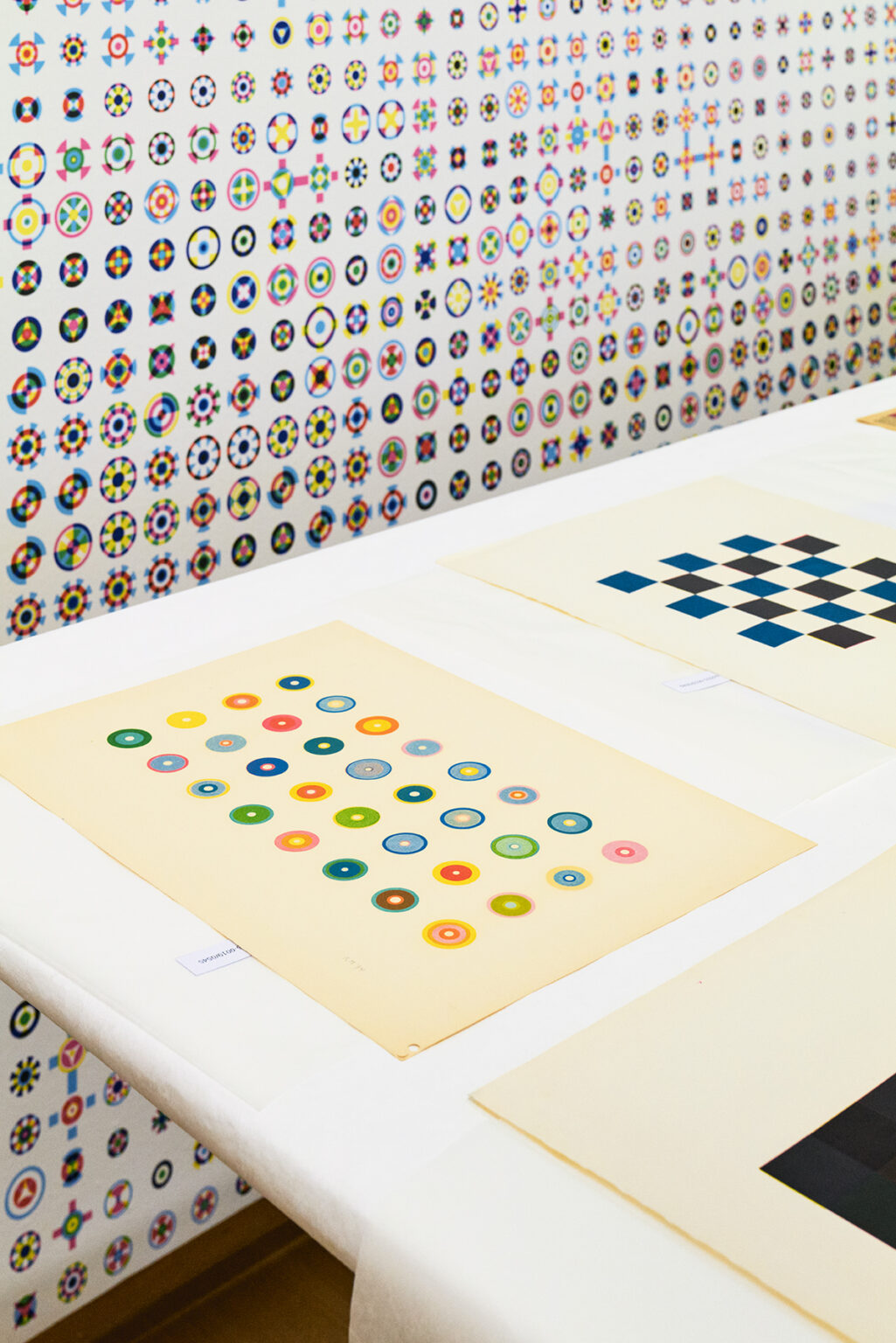
02. He’s having a solo show, aged 86, at the Stedelijk Museum in Amsterdam, titled ‘Unbound’, which runs until 26 October 2025. I can’t really imagine the major contemporary art museum of any other country giving itself over to a solo show of a graphic designer, even one as distinguished as KM. The status of graphic design in the Netherlands is quite exceptional. So much so that on two occasions graphic designers have served as directors of major museums: Willem Sandberg at the Stedelijk between 1945 and ’63, and Wim Crouwel at the Boijmans Van Beuningen Museum in Rotterdam from 1985 to ’93.
03. KM keeps two apartments in the same building. One to live in, and one as a studio. Both sit just above the water and have compellingly fluid views.
04. The studio refreshment is strong black coffee, served for visitors with plain tuile biscuits.
05. In his monograph ‘Printed Matter’, KM aimed to include every piece of work he had ever made. First published in 1996 on the occasion of KM being awarded the Dr. A.H. Heineken Prize for Art, it has been republished regularly ever since, first by Hyphen Press and later by Roma Publications. Each edition is expanded to include subsequent work, and there will be a new edition after the Stedelijk exhibition.
06. This book is foundational for graphic designers for many reasons. Here are some of them: KM has been making brilliant work since 1960; graphic designers are thrilled by completism; the book is bound with a French fold that allows for images right up to the edge, which is a rare and lovely quality; you can open it at any page and it will lie perfectly flat, also a rare and lovely quality; my oldest copy, which is the second edition from 2001, smells like a perfectly dried leaf.
07. KM currently works with his grown-up children Klaartje and Diederik in the design firm Martens and Martens.
08. His youngest daughter, Aagje, who is also a graphic designer, has collaborated with KM on many projects over the decades.
09. The children’s mother, Lous, never worked formally as an artist, but she made many beautiful things. These include a set of scrapbooks with images of animals for her grandchildren, which she made in dummies taken from KM’s studio. Later published by Roma in a single volume, this book is now in its third edition. For life-enhancing purposes, I strongly recommend buying yourself a copy.
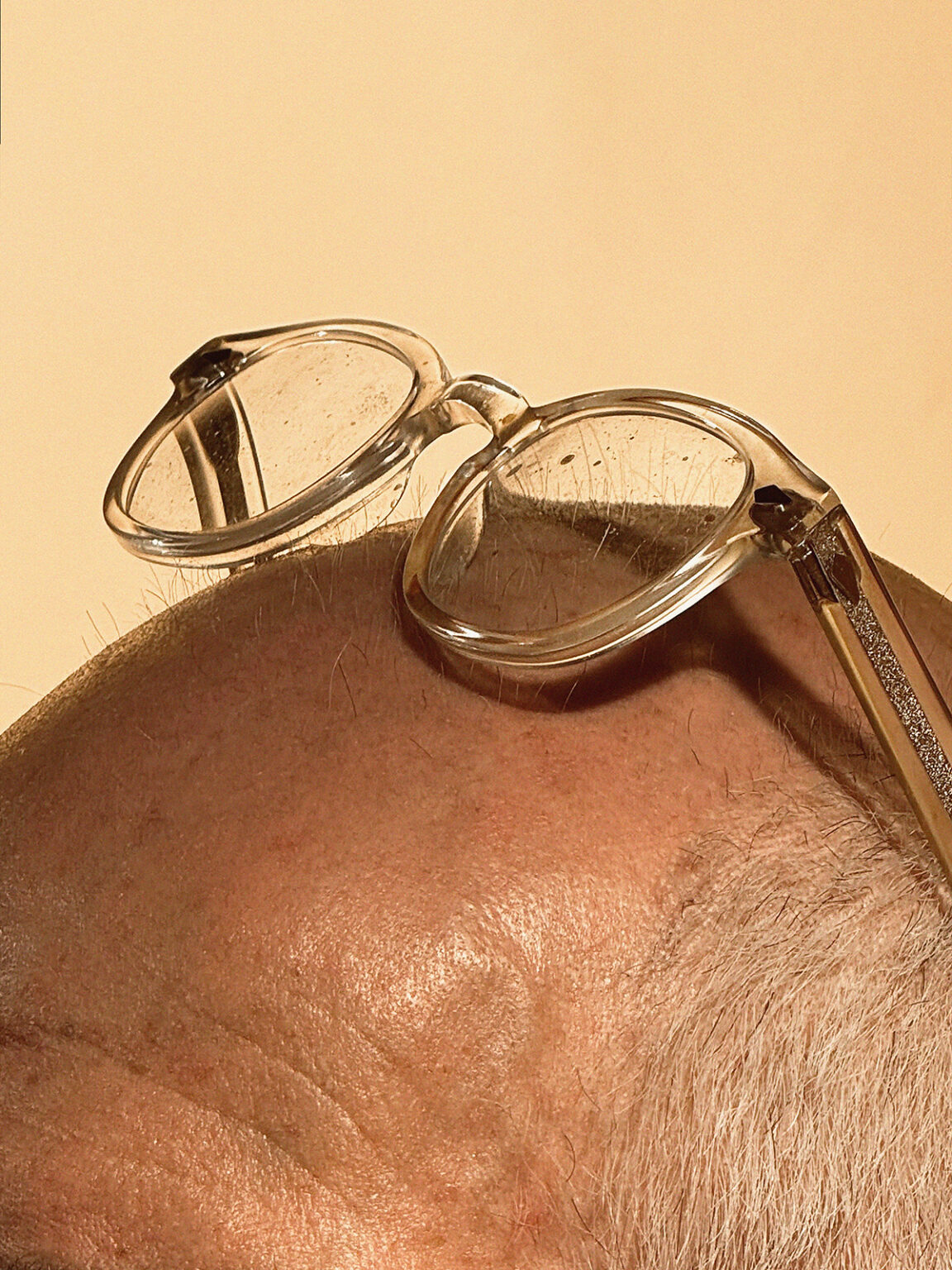
10. After over 60 years together with KM, Lous died in 2023. In his presence, I sense a broken heart.
11. KM has taught a generation of Dutch graphic designers, including Jop van Bennekom, the founder and creative director of this magazine. An eager student, Jop got himself noticed at his interview for the art school in Arnhem, where KM had taught since 1977, by looking up the work of his teachers in advance. Subsequently Jop got invited into KM’s “elite group” (Jop’s phrase) to work on some extracurricular projects and was exposed to lots of lengthy intellectual exchanges that set the tone for his subsequent aspirations.
12. In 1995, Jop followed KM to the Jan van Eyck Academie in Maastricht, where KM had just been employed to teach the MA course. Around the same time Jop lost his father. The relationship between them has some parental complexity. Their design is not at all alike formally, but I’d argue that Jop’s work is made in relation to KM’s. Jop is aware of the facets in his work of which KM does not approve.
13. KM is a father figure to many of his ex-students and employees. Both filmmaker Norbert ter Hall and Roma publisher Roger Willems express their relationship with KM in paternal terms. According to Roger, KM’s own father was an impecunious hotel owner whose irresponsibility left the young KM in a state of constant anxiety. Perhaps this panparenting is actively therapeutic for him.
14. Ex-student Norbert recalls the term “pampellen,” a word coined by KM to describe the sensory appreciation of print. It involves feeling the texture and the weight of paper, inhaling its smell and assessing its movement in the hand. Norbert likened it to connoisseurly wine-tasting. Na Kim, another former student of KM’s, talks of tacit knowledge, teaching by doing rather than talking. Na arrived in Arnhem from Seoul speaking little English and being incredibly shy. KM’s method suited her perfectly.
15. Jop remembers that KM always brought real examples to his classes, things like Eastern European matchboxes or envelopes that were a particularly beautiful colour. KM would encourage his students to reciprocate. He believes it is important to build an archive of beautiful things, so you always have examples to look at. At least, that’s what he told Jop, and it is advice Jop follows to this day.
16. KM was not formally trained as a graphic designer. His mentors at art school were artist and designer Henk Peeters and painter Adam Roskam. His entry into graphic design was through the former Arnhem publishing house Van Loghum Slaterus, for whom he designed many covers, mainly in a restrained yet playful geometric style.

17. Early KM work includes designs for the Socialistiese Uitgeverij Nijmegen (SUN), a socialist publishing house that had grown out of the revolutionary students’ movements of the late 1960s. Creating consistency among its books through a series of simple graphic devices, KM fused economic form with radical content. The SUN books are exemplars of left-wing publishing from that period.
18. He once printed his business card on a sticking plaster, and also on a one guilder phone card, which was, in fact, of his own design. Could there be any better way of ensuring that everything you disseminate into the world is of use?
19. Economy is a consistent characteristic of KM’s work. He draws the most out of every compositional and material element. Sandra Kassenaar, designer of ‘MacGuffin Magazine’, is constantly inspired by KM’s profound knowledge of the print process, which allows him to operate in an efficient and frugal manner.
20. In 1998, KM co-founded the Werkplaats Typografie, a satellite school of the Arnhem art school. The model of the school was revolutionary. In collaboration with Wigger Bierma, he imagined an MA teaching environment that would also be a working design studio, with students doing commercial work alongside their professors. Essentially, it was importing an apprentice model into the art school system.
21. Graphic designer Stuart Bertolotti-Bailey was the first student to enroll at the school, actually joining several months before it opened. Stuart remembers physically painting the walls.
22. Sadly, the school-as-working-studio model did not succeed, and although students still took on some commercial projects, the Werkplaats as a whole shifted toward a more conventional MA model. KM no longer teaches at the school.
23. KM was wearing blue workwear jackets, bought in France, long before they became ubiquitous.
24. He also has a good line in Fair Isle knitwear.
25. Until 2007, KM lived in a converted sports hall in Hoog-Keppel, a small village in the east of the Netherlands, not far from where he was born. The family kitchen and KM’s studio occupied the same space, and to the young Jop the idea you could make work right next to where you made dinner was revolutionary. Artist and designer Paul Elliman was a regular guest and remembers evenings by the fire in the main hall and delicious breakfasts made by Lous. Roger worked for KM in that space and recalls KM taking a nap every day, which required Roger to make himself scarce and not make a sound.
26. One time Paul arrived at Hoog-Keppel station to find that KM had forgotten to pick him up. The house was too far from the station to walk, so Paul had to take the train back to Amsterdam. The ticket office was closed and Paul got on the train without a ticket. Caught by a ticket officer, he refused to pay the fine and was arrested when he alighted from the train. Paul was teaching at the Werkplaats at the time and the administrator of the school had to retrieve him from a police station.


27. KM’s studio walls are extraordinary compositions of printed materials of all kinds. Sometimes his ex-students notice their own work in the mix. The wall at Hoog-Keppel is recorded in a short, animated film titled ‘Not for Resale’ that explores examples of print over a syncopated jazz soundtrack (available on Vimeo). Meanwhile the studio in Amsterdam – not just the wall but the whole environment – is documented in the picture book ‘Full Colour’, which was published on the occasion of KM’s solo show at the Ginza Graphic Gallery in Tokyo in 2013.
28. In the mid 1990s, KM worked on a book to celebrate his fellow graphic designer Wim Crouwel on Crouwel’s retirement from the Boijmans. Published in 1997 and titled ‘Mode en module’, its cover depicts the dapper, bow-tie-wearing Crouwel with a grid of printed disks of various sizes and colours. This book is now a rare collector’s item.
29. KM was in the archives of the Stedelijk Museum researching the Crouwel book when he noticed a bunch of redundant museum record cards heading toward the trash. He retrieved them and later they became the basis for an ongoing series of monoprints.
30. These prints are created with items such as found industrial objects and his children’s old Meccano sets, coated with primary-coloured inks.
31. KM uses a monumental 19th-century manual screw press that has been at the centre of his studio for decades, both in Hoog-Keppel and Amsterdam.
32. The press was inherited from his teacher Adam Roskam, who died prematurely from multiple sclerosis.
33. KM still operates its very heavy mechanism by himself.
34. Graphic designer, curator and occasional gallerist Prem Krishnamurthy showed KM’s monoprints in an exhibition in New York in 2012.
35. Prem had first encountered KM at Yale, where KM has been a visiting lecturer on the MFA programme since 1997. As such, he has had influence on graphic design not only in the Netherlands, but globally.
36. Having initially told Prem to hang them as he, Prem, saw fit, when KM saw a photograph of the hang, he told Prem that it looked like something his grandmother might have done. It was the day before the show and KM travelled from New Haven, where he was teaching at Yale, to New York to rehang the show that evening. KM then had to return to Yale for a day’s teaching before coming back to New York for the private view. There is photographic testimony that KM’s hang was infinitely better than Prem’s.
37. Prem sold KM’s work to many important international museum collections.
38. In 2014, I also staged an exhibition of KM’s work in collaboration with Prem in a small studio apartment in the Golden Lane Estate in London. KM was not the least bit tricky about how to hang this show, and we had a glorious celebration dinner at Leila’s Café in Shoreditch with the UK chapter of KM’s (unofficial) fan club.

39. Since 1990, starting with its 28th issue, KM has designed the architectural magazine ‘OASE’. Initially working on it alone, he later collaborated with students at the Werkplaats Typografie for each issue. It was seen as a special honour to be chosen by KM to work on the magazine. Since he left the school, he has worked on the publication with his daughter Aagje. The magazine is identified by its lack of identity. Each issue has a theme, and KM’s ambition is to reflect that topic in the design. Its size and shape remain constant, but its typographic style and layout vary from issue to issue. The design for ‘OASE’ forms a substantial part of the book ‘Printed Matter’, and it is also a major feature of the Stedelijk exhibition.
40. Ex-student and sometime colleague Na remembers him creating a meticulous 3mm grid as the basis for a layout and then disregarding it because something looked better shifted a little, by eye. He is happy both making and breaking rules. Another ex-student, Karl Nawrot, recalls him saying, “The grid is not a jail.”
41. KM is not afraid of changing course or bringing a new agent into his design, however late into the process.
42. He is drawn to happenstance, both the by-chance aspect of physical printing and the unexpected outcomes of digital design.
43. In 2017 he created a scheme whereby around 700 wooden cabins on the beach at Le Havre were painted with multicoloured stripes of various widths according to a scheme derived from the text of the founding decree of the French city, written in 1517. Although the decoration was based on a meticulous set of rules, the result appeared riotously various and colourful.
44. As his use of grids suggests, KM is drawn to complex mathematical systems, but he is never a slave to them.
45. KM speaks English with a strong Dutch accent and a characteristically Dutch manner. That is, he can be very direct. His ultimate put-down is: “I don’t understand it.”
46. Ex-student Rik Bas Backer believes that KM wants designs to speak for themselves, without need of lengthy explanation.
47. That said, KM’s views are never rigid. Na Kim created a tribute piece after the Le Havre project. Visiting the beach, she found numerous pebbles splashed with coloured paint. Forbidden from removing these stones themselves from the beach, she cast a couple of them in bright-coloured soft plastic. This was a contribution to an exhibition that KM was having in Seoul, but immediately he said that he didn’t understand its purpose. Later, however, Na received a photograph from him of his hand holding the stone against the background of his Amsterdam studio window, which offers an expansive vista of water.
48. He may not, in fact, ever have been as decisive as his students felt. His current design assistant, Susu Lee, occasionally resorts to the comeback: “You don’t need to understand it.”
49. In his days at the Jan van Eyck, KM had a roster of students that he could call for help with computer problems. He would work down the list to avoid overburdening a single student.
50. He has always functioned on the assumption that teachers have much to learn from their students.
51. KM never leaves his compositions in a “good enough,” say, 80 per cent state. Susu, who worked with him on the book published by Roma on the occasion of the Stedelijk exhibition ‘Unbound’, is impressed by his persistence, noting that he will stay working on a spread until it is a hundred per cent.

52. Francesca Lucchitta, who is a freelance book designer and archivist as well as being a longstanding KM enthusiast, was employed to sort out KM’s storage. Spending time in the Amsterdam studio, she was struck by his extraordinary level of concentration. She remembers KM sitting for many uninterrupted hours with a single piece.
53. Jop notes that KM’s work is always good.
54. The third member of the team on the ‘Unbound’ book was Jordi de Vetten, who is both Susu’s boyfriend and an employee of Roma. Inspired by KM’s own tenacity, Jordi and Susu spent months excavating every element of KM’s archive, both designs and found images.
55. KM is known for losing files on his computer. Days pass while he seeks them out. Susu suggests that KM’s studio could be named “Lost and Found.”
56. KM believes in having a beer after work.
57. Many years ago, KM persuaded writer and design publisher Robin Kinross to sit on the pavement of London’s Rivington Street while drinking beer. Robin Kinross has a notably monastic demeanour and this behaviour was uncharacteristic for him. Paul Elliman, who was also in the party, tells me that KM regarded it as a minor triumph.
58. KM is a regular guest at the birthday parties of his ex-students and fellow designers.
59. He is very sociable in a manner that is, according to Jop, “socialist,” i.e., everybody being on a par.
60. Travelling by bicycle around the streets of Amsterdam, KM doesn’t bother to wear a helmet if it’s only a short journey.
61. KM continues to work from his studio in Amsterdam every day on a whole variety of projects. These include textile designs and stationery with Martens and Martens.
62. But he is happiest, according to Roger from Roma, when he is alone with his press making monoprints.