Jordan Firstman
The first-time director tries to keep his mouth shut
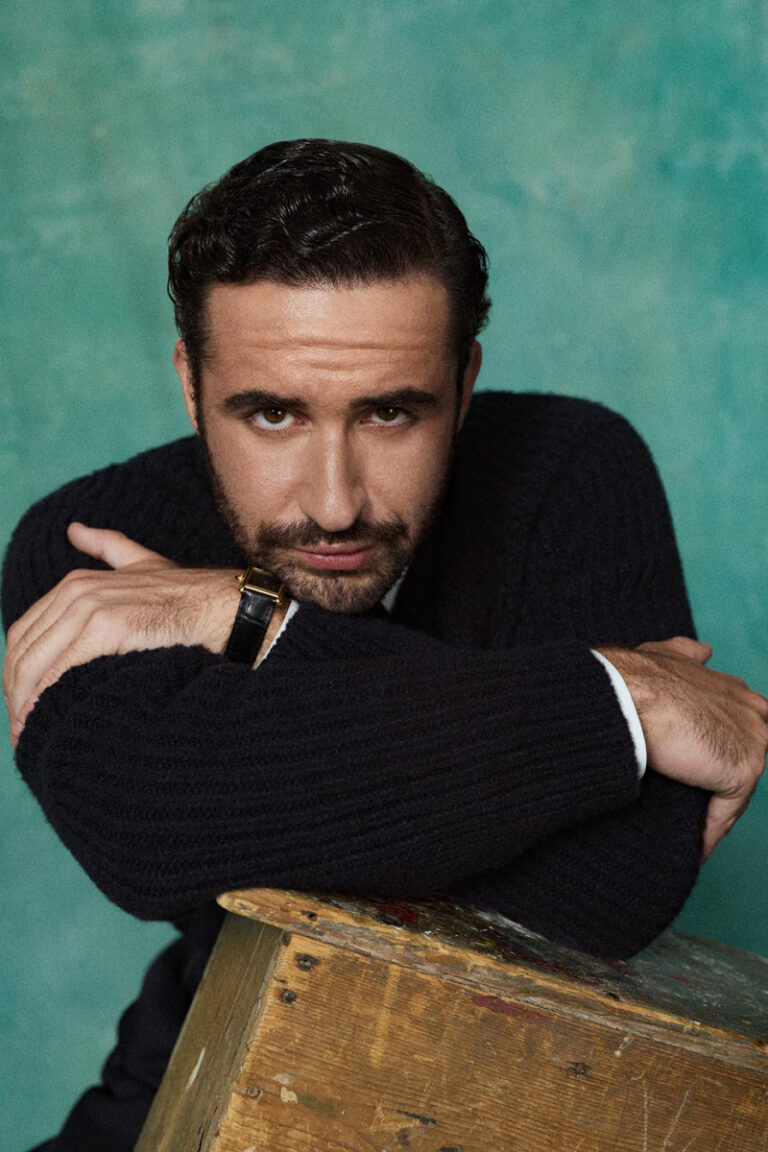
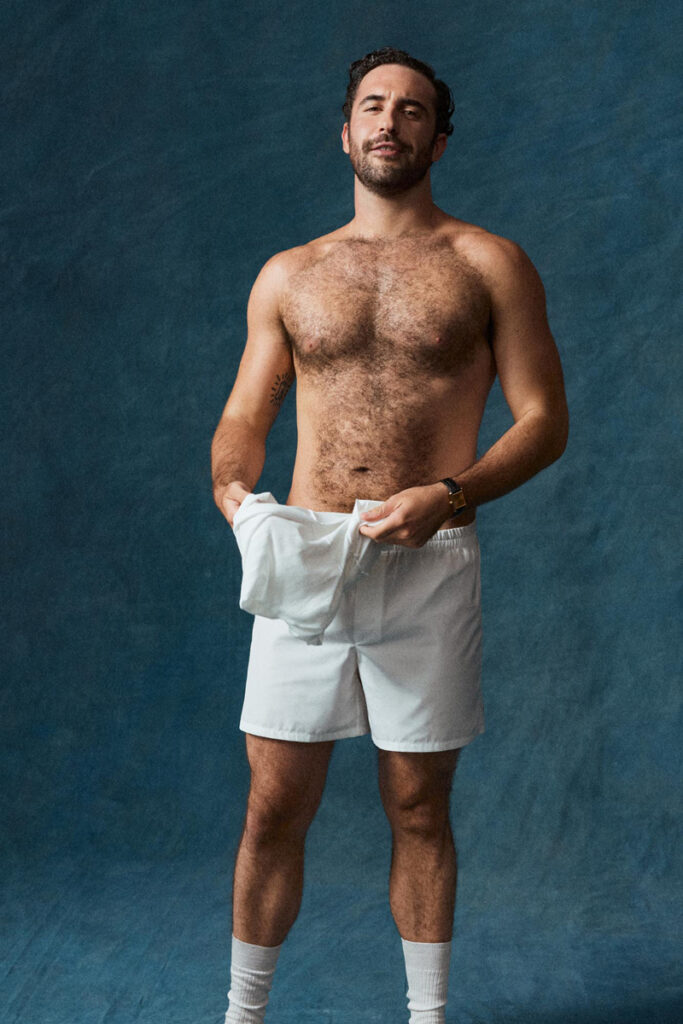
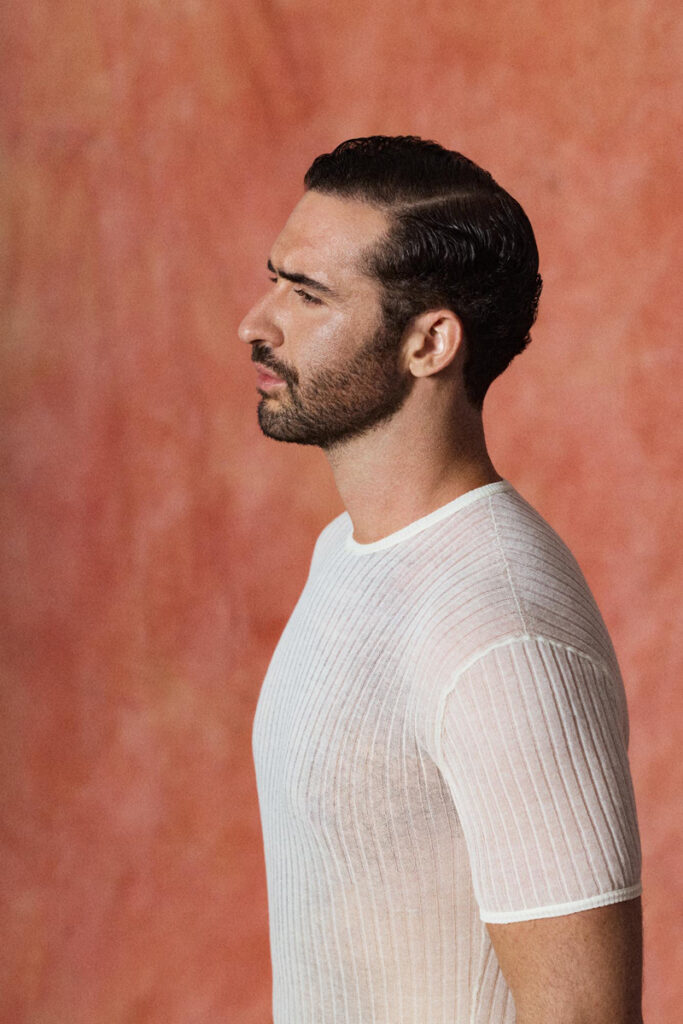
Jordan Firstman (American, 35 years old, completely fabulous) might be familiar to readers from his brassy internet memes, or his brilliant leading role in ‘Rotting in the Sun’, 2023’s crime thriller set in sexy Mexico. Or from the news that his debut as a director ‘Club Kid’ (which he also wrote and plays the lead in) was heralded with a seven-minute standing ovation at Cannes earlier this year and triggered a fierce bidding war between the biggest studios in Hollywood. A star was born.
Because he does so much, Jordan often struggles with knowing what to call himself. Luckily, help is at hand from Luca Guadagnino, Jordan’s friend of close to ten years and the director of ‘I Am Love’, ‘Call Me by Your Name’, ‘Queer’, ‘Challengers’ and so many other cinema highs. Here, Jordan gets some handy life advice from his fellow multi-tasking director, who also photographed and interviewed him for this story. The following Q&A has been edited for maximum readability and pleasure. Ready?
From Fantastic Man n° 43 – 2026
Text and photography by LUCA GUADAGNINO
Styling by GERRY O’KANE
JORDAN — Did I get too sunburnt?
LUCA — What, me or you?
J — Me.
L — A little bit. You’re a bit red, like a lobster. One second, baby, that’s not the beginning of the interview. It should start this way: Okay, Jordan Firstman has always been at the forefront of the most up-to-date things: the most up-to-date behaviour, the most up-to-date public persona. You have been directly and indirectly commenting on the state of the world and making fun of it and finding a way to showcase your personality and individuality. Eventually this has allowed you to be perceived as who you actually are. Not many people succeed in that. How do you see that in the face of the way the world works right now, the way in which authority expresses itself, the way in which parts of the world are in flames but not for the right reason?
J — Well, thank you. That’s a compliment, I think. I’ve always just tried to go from the inside out, and I’ve always known I’ve had a problem with saying everything that was on my mind, and I think it took, from high school, about a decade to figure out how to say that in a way that worked for me and didn’t hinder me. I remember my high school theatre teacher told me that I had special powers, and he said, “But you have to use your powers for good and not evil,” because I think he saw me. He saw that I was capable of both.
L — What kind of evil were you capable of at that stage in your life?
J — I’m able and have since I was a kid been able to see through things and speak honestly about them. He saw that I’ve always felt a strong sense of justice, and when people weren’t treating me or my peers right, I would be outlandish.
L — Is this something that comes out when you deal with power, or people in positions of power?
J — Until very recently this is how I have felt with a lot of people, where I think there is something hidden in their actions. Maybe they feel like I’m going to corrupt the system they have made, so they want to take my voice or my thing away from me, and I often respond very strongly to that.
L — I don’t know anyone, or at least haven’t met anyone in the last ten years, who has been able to express themselves through so many different mediums and through so many different types of performance in the way that you do. Whether that’s movies, or YouTube videos, or TV, or acting as an actor or writing as a writer or directing as a director. Is it possible that it’s a sort of victimisation of the self that helps propel you?
J — I believe I have been very, very lucky, but also, you know, I had to go to the internet because I had eight years of trying to develop ideas for TV that I just kept hitting walls with.
L — But do you agree with me, Jordan, that if you’d had fame and success, let’s say at the age of 22, 23, 24, just after theatre school, you would have become a horrible person?
J — I think it wouldn’t have been great for me. I don’t know if I would have become a horrible person, but I think I would have potentially self-destructed.
L — It’s so important to understand that maturity and success are better allies than success and youth.
J — Well, they say youth is wasted on the young, do they not?
L — I agree. Do you like younger men, men your age, or older men?
J — I usually like my age or older. Young people just end up annoying you in some way or another.
L — Do you despise people that are not fit, particularly men?
J — No, I envy them.
L — So, you envy me?
J — Of course. I envy you for many, many reasons.
L — No, no, I think the only reason you envy me is my belly and my lack of muscles.
J — I like your belly. I mean, I like a belly. I think it’s a classic gay thing, too, where we like to feel a body with some fluff on it, but we don’t want it for ourselves. I like a bigger guy.
L — One day, many, many years ago – I was very young – I met David LaChapelle, and I shot a tiny little documentary about him that I never edited. It must have been 1994, something like that, and David was super fit, and I was, like, 23 and he said to me, “Listen, as a gay man, I make sure that I’m very fit, because I have to offer something that someone else will recognise as attractive to them.” Do you think these politics are still valid?
J — I think so. It’s not only gay men, though. I mean, maybe it’s not straight men, but I don’t know. I feel we’re at a place in culture where everyone is being objectified. Male movie stars are being objectified purely for their appearance in ways they never have been, which I guess is a good thing. It’s great for women to kind of reclaim that gaze, but then it’s also got some sides that are not so positive. Every- where you look in Hollywood, everyone is bone thin, or every guy is on steroids.
L — What happened to body positivity?
J — I think it ebbs and flows. Everything that was cool in 2019 became not cool in 2022 and then whatever was cool then became not cool in 2025. Things just move very fast now.
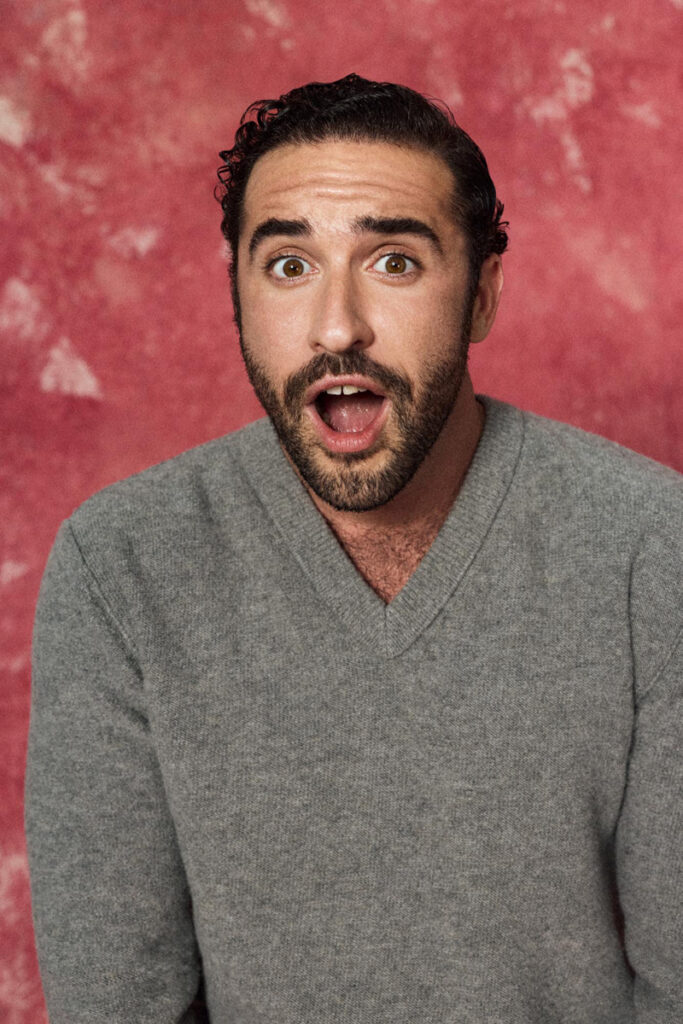
L — How many categories of men are there? If you had to take me on a journey through the labyrinth…
J — I’ve never subscribed to the whole “gay animal” thing. I think it’s very weird that we compare ourselves to animals. I don’t really understand that. A lot of people fall in between categories. I’ve always thought of myself as just a normal-looking gay guy.
L — When I met you, I thought you looked like a straight-acting gay guy. For a moment, I actually thought you were straight. Now I would say, first of all, you’re very handsome and very attractive, and it’s interesting because you’ve kept being so throughout the ten years that I’ve known you, which is great, so congratulations.
J — Thank you.
L — But I have to ask, would you see yourself in the otter category?
J — No! I don’t think I’m an otter, because I think of otters as a little thinner framed than I am. I think I’m a little bit bulky. I think I’m supposed to be… God wants me to be fat.
L — God wants you to be a bear.
J — Yes, God wants me to be a bear. Honestly, I hate these categories. It actually makes me feel sick.
L — One of the things that comes to mind when I think about you is your very emotional investment in autobiography. Everything is autobiographical: even in Rachel Sennott’s show, you appear as a version of yourself, which I think is a great thing, because, as you know, I love Bernardo Bertolucci, and Bertolucci always said movies should be documentaries about the actors playing the characters. Do you think this will always be the case for you, or do you think that – after these long apprenticeship years of expressing yourself through movies, through acting, through performing, through writing and directing – you will try to test yourself with a more transformative way of presenting yourself?
J — But you know, in ‘Club Kid’, there’s a lot of me in it but it’s not me or my story. With my favourite artists and film-makers I get this sense that I can tell what they are going through in their personal lives when I see their work. I think you are like that, even if you maybe don’t agree. I feel like Paul Thomas Anderson is the same way. Stephen Sondheim, not to be a total faggot about it, but, you can tell he wrote ‘Sweeney Todd’ when he hated the world, he wrote ‘Company’ when he was a single man and in his forties. So, I would like to be the type of artist that finds different stories to tell, based on where I’m at in my life.
L — You are already there. You know that, right? Even the movie that you did as an actor with the director whose name I constantly forget…
J — ‘Rotting in the Sun’.
L — ‘Rotting in the Sun’, by…?
J — Sebastián Silva.
L — Exactly, Sebastián Silva. Sebastián Silva is a mega cult director, he has an incredible following, he’s beloved by the most sophisticated critics, and he has a very, very strong personal voice as a film-maker.
J — Yes.
L — And then the movie ‘Rotting in the Sun’: it’s as much yours as it is his.
J — I couldn’t tell if you liked it when I sent it to you.
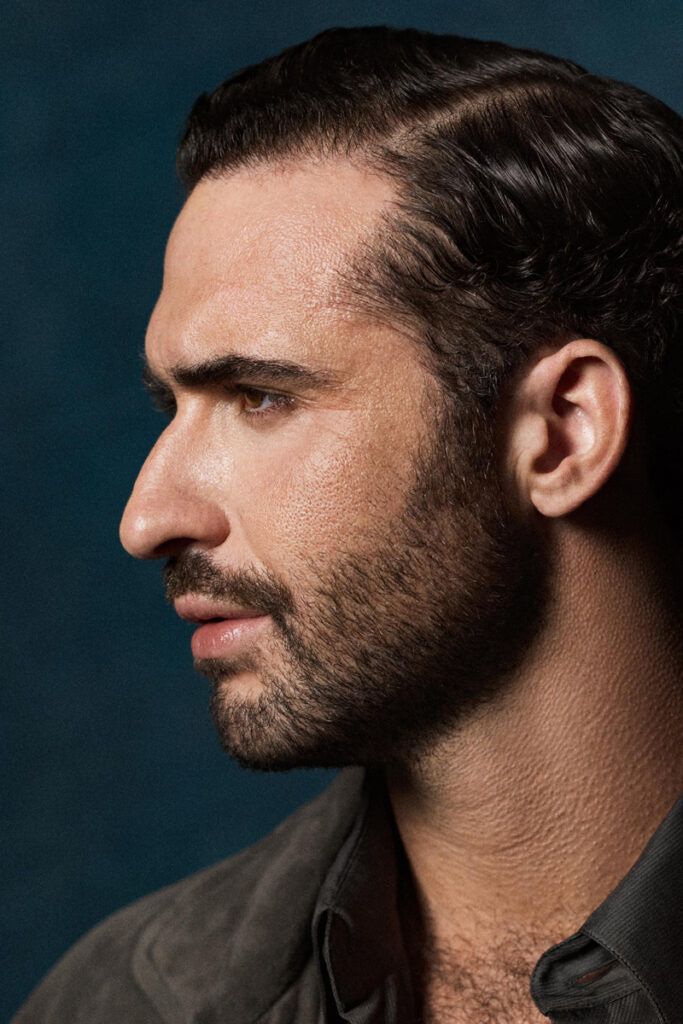
L — I think the movie pushed buttons in me that made me feel that I hated it, and then I watched it a few years later, because people kept saying how great the movie was, and I can see the greatness now. Sometimes you need to hate things in order to understand them.
J — A hundred per cent.
L — Okay, so you are now thinking, maybe next time I’ll put on a mask to cover myself, but I will still try to express the inside of myself, the inner emotions.
J — Yes. I’m interested in doing projects without me appearing in them. I think maybe for the next one I would still like to be in it, but then with the one after that I would like to explore something else. You know, what would my emotions and POV look like from a 60-year-old woman? I’d like to put my filter through different types of characters, and see how that lands.
L — ‘Club Kid’, a tear-jerker story of a father and a son, truthfully starts from an anguish-filled and tear-jerking experience in your life with a man, correct?
J — Yes.
L — Why did you feel that a father-and-son relationship was the best metaphor to tell the story of this lost love?
J — The movie really started from the very simple thought that me next to a kid is funny. I wanted to take my life – the way I live, the way I talk – and see what happened when there’s a ten-year-old boy suddenly there. But then I went through a break-up in the middle of writing it, and it became about something else, and when I watch it now, I can really see the metaphors of being both the parent and the child to someone you’re dating, and vice versa. There’s a lot of transference happening. I think it happened in a really natural way: just the more I worked on it, the deeper it got.
L — I think every character is you, particularly the two main characters. Or let’s say the main character, Peter.
J — I really love Peter, and there’s so many parts of Peter that I wish I was more like. I definitely pushed back on myself a couple times, wondering whether the characters in my movie were too good or too idealised. And I came to a place where I kind of wanted the characters to be good people. I feel that right now you don’t really see that so much. I feel like we’re in the anti-hero movement. It’s very in vogue.
L — What is the anti-hero movement?
J — In a lot of films currently every character needs to be a bit of a shitty person for it to be palatable, or to create a bit of distance between the audience and the character. I don’t want to name movies, but I think it’s very millennial, and very, very my generation to have this detached distance from the characters – almost as a protective shield.
L — I want you to name these movies.
J — I’m not… Luca, I told you, I’m growing up and learning how to keep my mouth shut in interviews, unlike some people… ‘F1’, is that the movie you shit-talked?
L — That was Jodie Foster. Jodie’s amazing. Do you know her?
J — But didn’t you say something about ‘F1’ too?
L — No. Jodie Foster made remarks about ‘F1’. She said that ‘F1’ seems to be a movie made with AI. What do you think of Jodie Foster?
J — I love…
L — Have you ever met Jodie Foster?
J — I have never met her. She’s the aunt of one of my dear friends and I’m scared to meet her because either she’s gonna love me or hate me, which is often the case with lesbians. But I think she’s a legend and amazing, and I hope she would like me.
L — But don’t you think the liking or the not liking will depend on how you present yourself?
J — Yes, but as you know, maybe I would get nervous and say something off-putting.
L — It seems to me that Jodie Foster is one of the brightest people you can meet in Hollywood. What would be off-putting to say to Jodie?
J — I don’t know, I would probably end up being, like, “Oh, you know, lesbians sometimes are like this or don’t like me,” and then she would be, like, “Oh, you think all lesbians are like that?” and I’d be, like, “No, no, not all lesbians, I’m sorry,” and then I would just put my foot in my mouth.
L — Next question. Do you have children?
J — I do. I have a child, and I have to be a little bit careful. I just can’t say any proper names.
L — How old?
J — She’s six months.
L — Okay? Do you think you’re the father?
J — No, I’m the…uncle. Right now, I’m the uncle who gave my cum away.
L — Wait, I just realised you have already told me this story and how personal it was, and it’s my bad that I asked you about it. It was unconscious because I was thinking of the character in ‘Club Kid’ – this gay man who discovers one day that he has a ten-year-old child. I was wondering if you think you could have a kid of around ten somewhere in the world that you are not aware of?
J — Sometimes I think I would be such a great dad, and I would love to have a kid to hang out with, and then sometimes I think I would be a horrible parent and ignore my kid and go off and eat at Erewhon by myself. One of the questions at the core of ‘Club Kid’ is: “What makes a kid?” Is love enough, or do you need to raise them in a traditional way for them to be all right? I think a lot of parents have kids when they are a bit stuck and they use the kid as a way to move to the next thing and hope that they will figure out, or learn, who they are through that, but often that doesn’t work. So I wanted to give Peter, the dad, the gift of time to not have drugs in his life, to not have partying, to have some form of stability.
L — That is your conservative side coming out.
J — I knew you were going to say this, because we’ve talked about it before together, and I’ve thought about it a lot since you said it. You said to me: “You’re a very conservative person,” but I think, no tea no shade, Luca, I’ve been in it, and when you’re in this hyper specific scene that I am just now kind of exiting, I think anyone who sees this movie that has experienced the G and the drugs and the state of it now knows it is not sustainable, you can’t end up there.
L — What were Jordan Firstman’s first five years of life like? Do you remember them? Where do you come from, what’s your hometown?
J — I’m from Long Island, a nice Jewish family with some bubblings of darkness underneath. It seemed nice to me at the time, and then, you know, you find out things. I guess, like any family, mine had their secrets.
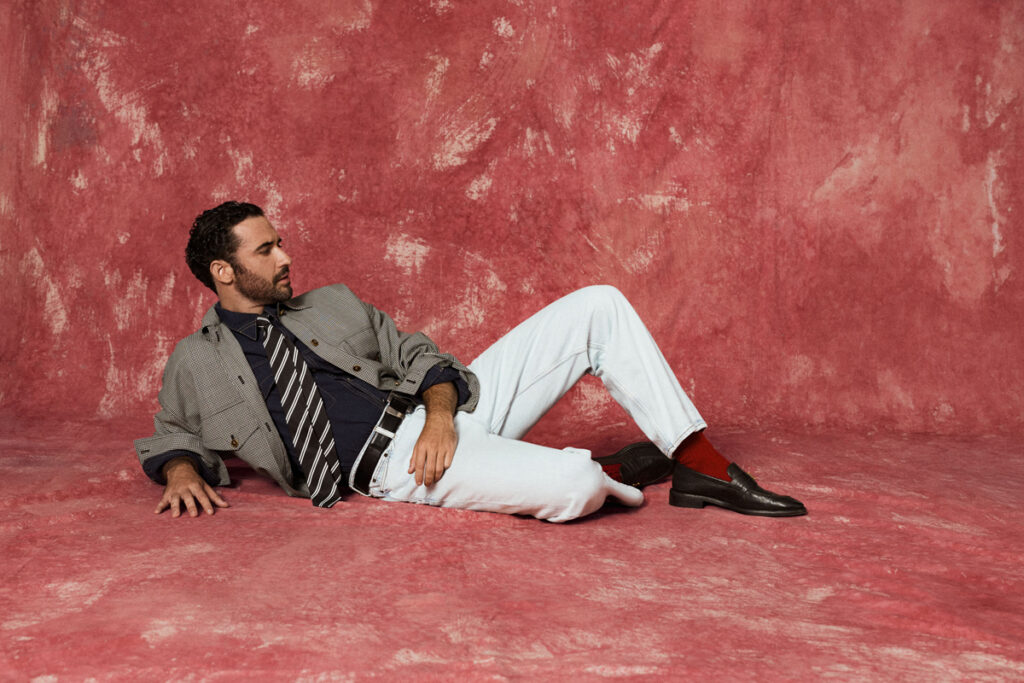
L — What’s the dark secret of your family that you want to disclose?
J — I really can’t say at this juncture, but hopefully I will be able to, I don’t know, make something about it one day. But just a lot of lies, a lot of financial stuff that was being lied about and some familial generational trauma kind of stuff. But I can’t really talk about it.
L — You grew up in the ’80s, right, or in the ’90s?
J — In the ’90s. I was born in ’91. I do remember it being very, very nice, very, very peaceful. I was very shy, I was very sweet, I was smiling a lot. I started to be kind of funny around, like, five. I would watch ‘Seinfeld’ with my parents and do Kramer impressions, so I think that’s when that started. I think people are surprised when they meet me, and I can sometimes be a little shy. I’ve learned how to be an extrovert, but I think my true self is a bit shy.
L — Like pretty much all the comedians and, I would say, all the talented people.
J — I think creative people often have a lot going on in their minds, and it can be very overwhelming or overstimulating when they meet people. Especially as a somewhat public person, people come up to me all the time, and they have some sort of perception of me, so they want to have a certain vibe.
L — Do they all want to have sex with you?
J — No, the ones who want to have sex with me talk shit about me on Twitter and don’t come up to me in real life, and the ones who do come up to me are, like, usually very, very nice, but they want to banter. I think, through the nature of my work, I’ve created that lack of boundary, maybe, especially when I was doing this stuff online. People just come up and want to immediately have a rapport with me, joke around, and most of the time I’m not in the place to want to do that.
L — Why?
J — I don’t know. I think joking is such a personal thing; you have to be with someone that you trust. For me, I can’t just joke around.
L — So at the age of five, you started to exhibit some comedic tendencies. But when would you say you started to realise it was something really fundamental about yourself?
J — I would say I honestly started getting what comedy was when I started watching Woody Allen in high school.
L — You know Woody Allen is not mentionable as an artist.
J — But I was in high school! I didn’t know the things that I know now.
L — You are gonna be in trouble quoting Woody Allen in an interview.
J — You can’t say you watched Woody Allen as a high schooler?
L — I already had a lot of shit with making my movie ‘After the Hunt’, having the title sequence paying homage to his movies. How do we get off of the Woody Allen?
J — Okay, okay, I’m gonna think of something else…
L — No no, Woody Allen is now within the interview; we can’t remove him. But how do we reassure the readers that we are good people?
J — I do not condone anything that ever happened in his personal life. I think he genuinely is a sick person and I genuinely do think that he became disturbed at some point. But when I was in high school and was someone who didn’t know anything about his personal life, the way he wrote characters was very new to me, and I found it very interesting. When I was in high school all I wanted to be was affluent.
L — Did you like Brian De Palma when you were growing up?
J — I didn’t watch any De Palma until my early twenties.
L — Okay, so that didn’t have any power or influence on your upbringing?
J — No, but when I discovered Paul Mazursky, that was the real wake-up call for me as an artist. Because even Woody Allen, his dialogue is very arch in a lot of ways; it’s very pointed, it’s very sharp. But Paul Mazursky, when I saw that, I was, like, “Oh my god,” because it had a naturalism that not many funny movies I loved had, but it still had this edge of observation and humour. But the edges were really soft. The dialogue felt very soft to me, and when I saw ‘Bob & Carol & Ted & Alice’ I just fucking lost my shit. That really shaped the way I’ve written. That and ‘Enlightened’, the Mike White show. Those were the two things I saw in my early twenties where I was, like, “Okay, this is the type of writing I would love to do.”
L — I think that the idea that you quote Paul Mazursky is fantastic. I love that director. There was another Paul that I love, which was Paul Bartel, and there is one movie called ‘Scenes from the Class Struggle in Beverly Hills’ that I think you’ll love very much.
J — I’m gonna watch it.
L — I’m offering you an idea to watch the movie, love the movie, and maybe remake the movie, because it’s one of the great movies of the late ’80s, and it’s very Jordan Firstman, so watch that.
J — Okay, I want to watch.
L — Now that you’ve done ‘Club Kid’, and since I saw the movie, I don’t think of you as an actor or as a comedian anymore. I think of you as a director, and I think that will be forever. Did you want to be a director forever?
J — No, I think I would say a film-maker. I hate to say it, but film-maker feels like the right term to me.
L — Stop it now.
J — It feels…autonomous.
L — No darling, that’s wrong. “Directed by” is the most noble thing you can think of when you go to the cinema. “Directed by John Ford.” He’s a director, and the director is the quintessential personality of cinema.
J — The person that gets all the autonomy is the director, but I think the writing is so important, and they very rarely write.
L — How do we deal with the fact that many of the greatest directors of all time, and many of the greatest movies, have been directed by directors who didn’t write?
J — I don’t know how to deal with that.
L — Would you work with a script that you’ve been handed but didn’t write yourself?
J — It’s tough for me. I’m new right now. It doesn’t feel so appealing to me. I’m definitely getting scripts sent to me but they just don’t do it for me.
L — I think the fact that you aren’t getting any good scripts is normal, because 90 percent of scripts are not good, or not good enough: they are too formulaic, they don’t have a real point of view, they are derivative, and so on. But that has been the same since forever. When you meet a great writer with a great script, that’s the moment in which you, as a director, are completely freed. So, I want Jordan Firstman to consider the possibility of working with a writer in the future, and to be a director: “Directed by Jordan Firstman.”
J — I’m open to it right now.
L — I don’t think you’re open to it.
J — I’m open to a world where I’m open to it.
L — When you were in Cannes, did you think, “Damn it. Why didn’t they put me in the competition?”
J — No, I promise you. Not for one second. How could I feel anything but, “What the fuck is happening?”
L — Were you upset that you didn’t win Un Certain Regard?
J — I think I was upset for three hours.
L — You were?!
J — Genuinely, I was bummed for three hours. But you know, I understood the decision. You know, you can never really be sad about losing something. I’ll probably say this 20 more times in the course of the next year, but this is the first time I’m saying it: genuinely, when we wrapped production on ‘Club Kid’, I felt so lucky for the experience and what it opened up in me and for getting to not only do it but do it my way, that everything else feels like a bonus.
L — How will you prepare yourself for the award season?
J — Stay in the gym. Try not to drink. I want to figure out how to be myself, but not say anything too outlandish. I want to stay on people’s good sides. I don’t know, it’s gonna be my first release, so I just…I want to stay present, I want to stay alert, I want to be able to do this again, so I want to do everything I can to ensure that I’m able to, you know, make another movie the way I want to make it.
L — Can I give you a tiny little bit of advice? I don’t want it to sound paternalistic, or like I’m patronising you, though.
J — Please, tell me.
L — Shoot your next movie within the next ten months.
J — Luca.
L — Immediately.
J — It’s not possible.
L — You must do it.
J — Can you give me an extension…
L — Twelve months, 14 max.
J — Okay, 14 months from now.
L — It means basically you being on set in March. Can you do that?
J — No.
L — Are you writing something?
J — I am. I have the idea, but I don’t want to give a timeline.
L — All the people who are reading this interview are completely rooting for you and want you to keep going without the industry timelines. Make a movie in a year.
J — I am going to try to go as fast as I can. But I want it to be good. I want to have time to rewrite it and work on it. You know what I mean.
L — I do, absolutely. Jordan, have you ever used your smile as a weapon?
J — Definitely.
L — When did you realise your smile was a weapon?
J — I think honestly pretty young, and I definitely used it romantically a lot in my twenties.
L — Have you ghosted lovers that you charmed with your smile?
J — I’m not a ghoster, believe it or not. I’m pretty open, and I think I’m very clear with what I’m looking for in people.
L — Let’s enact a scenario where you break up with me.
J — Um, hey, Luca.
L — Hey.
J — I have had so much fun spending time with you, and I hope we can keep spending time. I think romantically I’m not really looking for this right now, but I think you’re amazing.
L — What are you looking for?
J — I don’t know, I don’t know, but I think I just need to keep my options open right now, and I hope we can still hang out. I’m a huge fan of everything you do. I think you’re so handsome and beautiful, and I know I really believe that. I swear, Luca, I really believe this.
L — Jordan, you are full of shit. And you’re using the smile. This is on the record: he’s using the smile to kill me!
J — That is how I would do it. Don’t you think that was a very kind way to break up with someone?
L — No, I think it’s formulaic. It’s a bad script.
J — I believed it, though.
L — It was a very good improvisation. I think the people will love it.
Photographic assistance by Jacopo Vimercati and Nicolò Rampazzo. Digital operation by Emanuele de Rossi. Styling assistance by Ilaria Taccini. Hair by Alessandro Rebecchi at Artlist Paris. Tailoring by Camilla Masi. Set design by Flavia Manacorda. Production by Frenesy.