Bill Skarsgård
Day-to-day with the Swedish actor
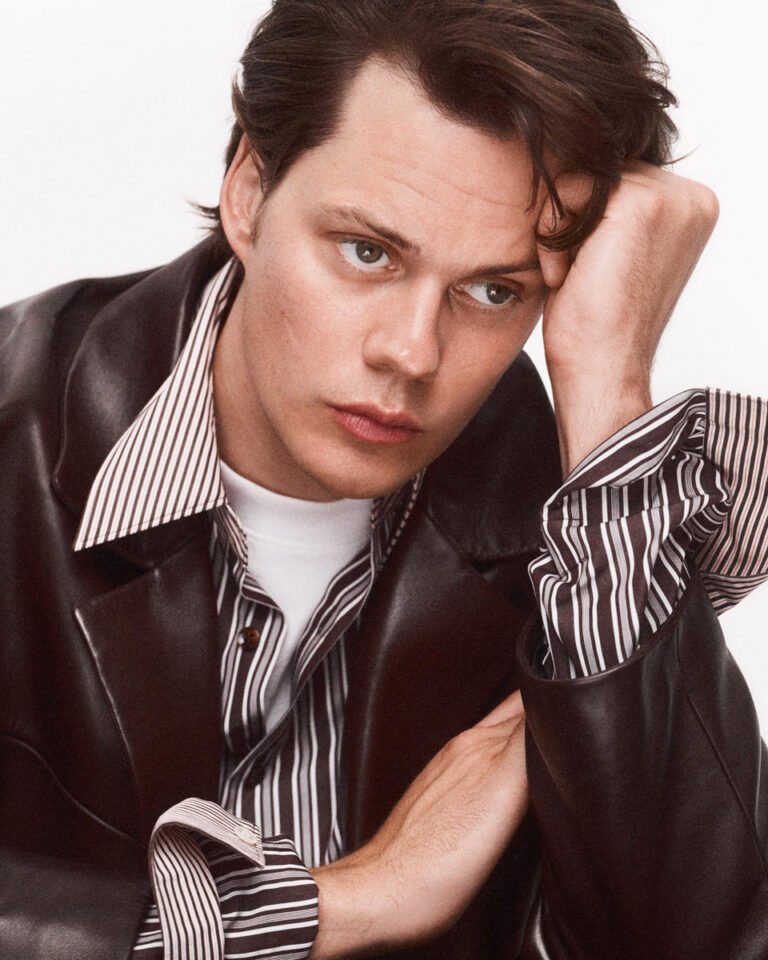
— Killer clown.
— Ancient, blood-sucking nobleman.
— French assassin.
— Disgruntled real estate broker.
— Doomed Airbnb guest.
— Medieval sidekick.
— Gothic crimefighter.
— Wholesome American football player.
— Hapless car thief.
— Thousand-year-old supervillain with tentacles.
The breadth of Bill Skarsgård’s roles is as impressive as it is unpredictable. Despite being well-known for playing outlandish characters with lots of prosthetics, he’s just as happy playing relatively normal guys and plans his roles carefully so that a blockbuster is always followed by a proper indie film. Off-screen, the Swedish actor lives a private and calm life, surrounded by old friends and his family, of whom an almost ridiculous number share his same line of work. Let’s step out for a walking tour of Stockholm, where he’s continually recognised but still able to feel like a regular person.
From Fantastic Man n° 43 – 2026
Text by DOUGLAS GREENWOOD
Photography by ILYA LIPKIN
Styling by HISATO TASAKA
Bill Skarsgård leans over and looks out of the restaurant window, into the park he used to play in when he was growing up. When the actor, now 36, was old enough to leave the house alone, he and his friends would run around there, occasionally stumbling upon poorly stashed piles of old porn magazines behind bushes. It feels like home to him because, for most of his life, it has been. Even when he’s catapulted to a different continent to make films or TV shows or for the press tours that follow them, the rubber band always pings him back to Stockholm.
In particular, it’s this neighbourhood of Stockholm: Södermalm, one of the 14 islands that make up the Swedish capital. Once farmland, it developed into the city’s working-class district. Some historians would even say it used to be a slum. To really understand Skarsgård, you have to come here. The place we meet – an abandoned women’s refuge turned upmarket hotel restaurant (Google rating: 3.7) – is significant because he remembers it as it used to be: derelict and uncared for. Since Skarsgård’s birth in 1990, the area has become progressively more bohemian, more gentrified. “This is our Williamsburg,” he says. His whole family, including all seven of his siblings and half siblings, still live within walking distance of it.
Of this immediate family, an almost preposterous number are actors:
— Stellan Skarsgård (75)
The father. The man who last year earned an overdue Oscar nomination for the film-making family drama ‘Sentimental Value’, after having made his name in ‘Good Will Hunting’ and Lars von Trier’s most murky movies.
— Alexander Skarsgård (50)
Stellan’s eldest son. You will know him from vampire series ‘True Blood’, his kinky turn in the BDSM romance ‘Pillion’, and his tendency to disobey straight dress codes on red carpets.
— Gustaf Skarsgård (45)
Another of Bill’s older brothers. Quietly prolific – appearing in Nordic noir series and the Oscar-winning ‘Oppenheimer’. Between 2013 and 2020, he starred in all six seasons of History Channel’s series ‘Vikings’, playing Floki, a boatmaker.
— Valter Skarsgård (30)
Stellan’s youngest son from his marriage to My Skarsgård, a therapist and counsellor whom he divorced in 2007. Valter appeared in black-metal horror movie ‘Lords of Chaos’, opposite Sky Ferreira.
— Ossian and Kolbjörn Skarsgård (17 and 14)
Bill’s half brothers, born to Stellan’s second wife, Megan Everett-Skarsgård, a producer. They’re just getting started, doing voice work and small cameos.

And then there’s Bill. The middle kid with mad ideas. The one who – according to most profiles written about him over the past ten years – goes deep and dark, choosing parts that permit him to disappear under the skin of monsters. Sitting across from Bill, who is dressed in a cap, dark trousers, and a Tiger of Sweden jacket, you can see elements from these otherwise unrecognisable characters, hidden within his face and posture.
Does he agree with that interpretation? “Absolutely not,” he says. “I get asked regularly, ‘How does it feel to do something without prosthetics?’ when 98 per cent of my jobs don’t feature prosthetics. It’s just the exposure you get from the jobs that tend to define you.”
One of those defining jobs is the one most people have seen, even if they wouldn’t recognise Skarsgård within it. In the 2017 adaptation of ‘It’, Stephen King’s twisted clown horror, Skarsgård is buried beneath the marshmallow cheeks and fanged grin of Pennywise, its villain. The other film he’s referring to is 2024’s ‘Nosferatu’, from horror auteur Robert Eggers. To play the centuries-old Transylvanian nobleman Count Orlok, Skarsgård spent hours in the prosthetics chair and contorted his voice with the help of an opera teacher to reach a growly lower octave. But beneath his rotting flesh, Skarsgård was able to capture a magnetism so convincingly that ‘Men’s Health’ – along with large swathes of social media – dubbed his character “2024’s sexiest man.”
These films, both well received and commercially successful, allowed Skarsgård to flex his freakish ability to transform. That’s good because Skarsgård is an all-in kind of guy, who has a tendency to give as much of himself as he can, even if the project warranted a simpler approach. During the making of ‘Nosferatu’, he isolated himself from his castmates for most of the shoot. To lead the 2024 remake of ‘The Crow’, he followed a strict diet, largely composed of steak tartare and raw eggs.
“You just don’t notice what it takes from you, or how it consumes you when you’re doing it,” he says, reflecting on the commitment he tends to put in for his roles. “It’s hard to be self-aware enough [to recognise it], until my partner says, ‘Yeah, you’re dark.’”
And despite all of that, it’s not uncommon for Skarsgård to watch something he broke his back to make, and soon realise: “It’s just two hours of popcorn.” So he’s made a pact with himself: one large-scale genre project – a horror, fantasy, or thriller – and then a weird, indie drama that barely a fraction of that larger film’s audience will see. It’s a to-and-fro to keep his juices flowing.

“Film-making is an incredibly complex mess,” Skarsgård reflects. Because of the draining and often all-consuming nature of his profession, the actor tends to cultivate some distance when not on set, spending time with his family or with people in other creative worlds with whom he can find some common ground without being dragged into shop-talk. Sudanese-Canadian musician Mustafa has spent some time in Stockholm working on new music. A year or so ago, when he first decided to write there, he was looking for a place to crash. “I didn’t want to stay in a hotel the entire month, so I asked a friend if they knew of anyone who was renting their house out, and they connected me to Alexander Skarsgård,” he says. “A few months later, he invited me to the premiere for a movie he was in called ‘Lee’, in London, and Bill was there. He was talking about how he liked my music, so we exchanged numbers.”
Since then, they have become “very close friends.” Whenever they are in the same city, they tend to hang around together in the studio, along with Mustafa’s collaborators, including Dev Hynes and Daniel Caesar. “I’m very envious of their sessions,” Bill says. “The control and the freedom of their art. So much of it is being in a room with other artists, vibing. You can make a masterpiece in an afternoon.”
So far they have spent time in studios in at least three different countries: Stockholm’s Ingrid Studios, London’s RAK Studios, and New York’s Electric Lady Studios. Mustafa tells me that, in one of their Electric Lady sessions, Skarsgård recited lyrics written by Hynes in the voice of Count Orlok. “There is a play that he defends with the life of him,” Mustafa says. Despite what Skarsgård thinks, Mustafa sees his friend as “a very sovereign person. He doesn’t have this pernicious desire to have a dominion over Hollywood. That’s a testament to his artistry, and the fact that he cares about making the right decisions.”
Skarsgård hasn’t been on a film set since February. That’s an active decision he made after working on four productions back-to-back over the course of a year, on an itinerary that took him across the globe, sometimes with barely a weekend of rest between projects.
— Louisville, Kentucky, US
In January 2025, Skarsgård travelled here with Gus Van Sant to make ‘Dead Man’s Wire’, a crime caper inspired by the real-life story of a would-be real estate broker holding a mortgage lender hostage. The shoot lasted 19 days, with Skarsgård playing the lead. Van Sant had seen Skarsgård in the 2022 horror film ‘Barbarian’, in which he plays an Airbnb guest who gets caught up in a rental’s violent secrets. “It kind of took me a second to figure out who he was, because he was playing a very ordinary character, more than any of the others I’d seen him play,” Van Sant says. It made him realise that Skarsgård had an interest in playing such parts. Until that point, “I didn’t know whether that was off limits for him.” During their time in Louisville, Van Sant says that Skarsgård managed to hit up a few bourbon bars with the film’s financiers – and still make it to set the next morning. He’d frequently do a perfect imitation of Sean Connery to make everyone laugh. This boisterousness and sense of humour, Van Sant says, reminded him of Bill’s father. Van Sant famously worked with Stellan on the Oscar-winning 1997 film ‘Good Will Hunting’. “I had actually met all the kids, including Bill, when they were visiting for a week or two towards the end of the shoot,” Van Sant recalls. He still has a picture of them all together.
— Rural Northern Ireland
Skarsgård spent just two weeks in Northern Ireland playing Little John in ‘The Death of Robin Hood’, a heady and violent adaptation of the 17th-century ballad. It was a reprieve, he says, from the responsibility of ‘Dead Man’s Wire’. Here, he has just a handful of scenes.
— Queensland, Australia
In August of 2025, Skarsgård started shooting ‘The Mosquito Bowl’. Produced by Netflix, the film is a big-budget sports drama adapted from the bestselling non-fiction book of the same name by journalist Buzz Bissinger. The Mosquito Bowl was a game of American football played by soldiers while they prepared for the Battle of Okinawa. Skarsgård plays one of the core soldiers, alongside British heart-throb Nicholas Galitzine, Ray Nicholson (son of Jack), and Broadway actor Tom Francis. For six weeks of the film’s four-month shoot, Skarsgård invited his partner and their two children to Queensland. “My daughter snorkelled for the first time at the Great Barrier Reef,” Skarsgård recalls. “The job was amazing in and of itself, but to have that family memory made it even more incredible.” It’s set to premiere later this year.
— Belgium, Morocco, and Hungary
Skarsgård ended 2025 by diving into another big-genre project: ‘Lords of War’ – a sequel to the 2005 crime film which featured Nicolas Cage as an arms trafficker. Over the course of several months, the project took him to various locations across Europe and North Africa, before wrapping in early 2026.

He describes that churn of film productions as “aggressive,” especially as the father of two young children whom he wants to be around for. “I also felt kind of depleted afterwards. You pretend to be different people, and so you’re removed from yourself and your life. Now I’m, like, ‘Who’s Bill?’ you know?”
“What were you like in school?” I ask, veering away from the topic of work.
He slips his jacket on and says: “Why don’t we take a walk?”
Europe is in the grip of a summer heatwave but Stockholm is overcast, the sky a uniform cast-iron grey. It rained so heavily last night you have to avoid puddles on the pavement. Skarsgård, jacket on, cap pulled politely over his eyes, points down the street between two buildings, and I follow his lead.
“These streets feel like they’re mine,” he says, because he’s wandered them forever. There’s an unwritten code in Södermalm, where Skarsgård spottings are almost as common as pigeons. If a local spots a Skarsgård, there might be a polite acknowledgement, but no one causes a scene. “Here it doesn’t matter, because it feels like they’re in my living room. If I’m in another borough, it feels different.”
This attitude towards the family is largely rooted in two things: their good behaviour and a different approach to fame in Sweden. The Skarsgård dynasty have built a positive reputation amongst locals because they do good work and seldom find themselves caught up in tabloid hysteria. They do not offer themselves up for public consumption in the way stars in America do. For example, there is an Instagram account under Bill Skarsgård’s name with over a million followers – but it does not belong to him. For a man who permeates so much of pop culture and, by dint of this, is globally famous, he has little to no interest in exacerbating that fame. He has, to date, appeared in two superhero movies. His first was the R-rated Marvel comedy ‘Deadpool 2’. He played a mutant named Zeitgeist who is able to spit acidic vomit and, after a very brief appearance, dies in a comical accident. He also appears in Chloé Zhao’s ‘Eternals’, a film famous for taking the Marvel franchise in a more cerebral direction. Lucky for Skarsgård’s ambivalence towards fame, he appeared via voice only, and the movie flopped.
We are walking the same streets that baby Bill Skarsgård did, first in a pushchair, next in the arms of his mother and father, then as a teenager, a flyspeck away from adult responsibility. “It feels like I know my roots here,” he says. “[It’s] like a small town where you know everybody.” We make a detour to check out his former primary school, which is painted in an off-kilter colour. He passes it all the time but hasn’t been inside since he left there. On evenings when it’s closed, he might stroll by and peek through the window to see what’s changed. Between grades one and six, “all of us went here,” Skarsgård says, listing off his siblings.
Skarsgård’s father, Stellan, moved to Stockholm in 1972, joining the ensemble of the Royal Dramatic Theatre at the age of 21. Stellan was the first in his family to properly pursue a creative endeavour, kickstarting what has become something of a family business. His dad’s father, Bill says, was “a really shitty accountant with the soul of an artist. He wanted to be an actor.” His mother’s father was a dentist by trade. If you look back far through their family history you’ll find that most of the Skarsgård clan, on both sides, were seafarers, drawn to the water.
Before relocating to Stockholm, Stellan had moved around a lot as a child, spending summer vacations in the coastal town of Kalmar. They continue to return to their roots by visiting a country house on an island nearby. “My great-grandfather built it in 1924,” Skarsgård says, “So my granddad spent every summer there, my dad spent every summer there, and we spent summers there as kids.”
The whole family will go to the country house soon to celebrate Midsommar, the Swedish holiday. To the non-Swedish layman, its reputation has been maimed slightly by the gnarly A24 horror movie of the same name, in which a group of visiting tourists fall victim to a murderous cult while celebrating the holiday. Skarsgård assures that there’s very little crossover. “It’s kind of like a New Year’s Eve, like a drinking holiday, but to mark the start of the summer” he says. No human sacrifice. “Once you start having kids, other people are bringing their kids, and it becomes like a different thing, but when you’re younger, it’s all about getting fucked up. Everybody has that one Midsommar where you’re in a state of delirium.” I ask if he has a story about a Midsommar of his youth. “I do!” he says, laughing coyly. “I just don’t want to tell you.”
Before he decided to be an actor, Bill at least initially resisted the desire to follow in his father’s and brothers’ footsteps, instead leaning into academia. He majored in natural sciences, and earned good enough grades to go on to study at medical school if he had wanted to. Although this might sound like a rejection of family tradition, it actually placed him within another impressive, albeit less glitzy, Skarsgård vocation: both his mother and Sam, his 44-year-old brother, are physicians. He would later obviously change his mind, making his adult acting debut in a Swedish comedy called ‘Simple Simon’.
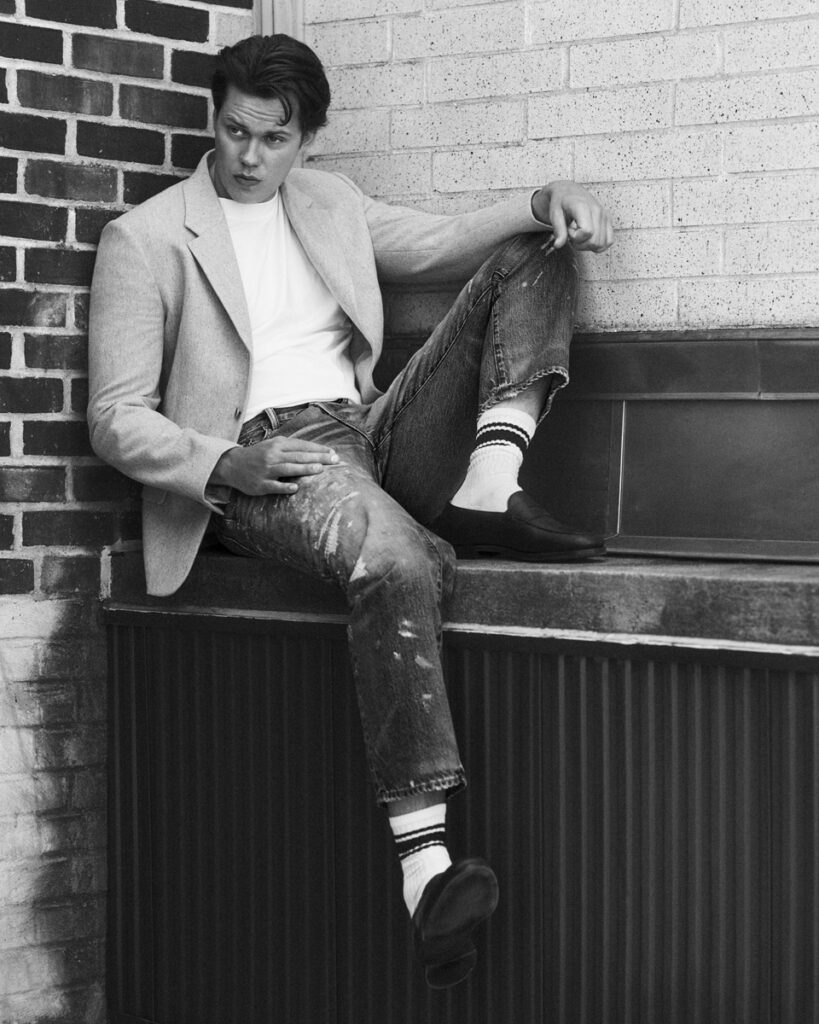

Most of Skarsgård’s academic hard work happened in the building he’s led me to: Södra Latin, a late-19th-century red-brick building that sits atop the island of Södermalm. Past alumni of the school include:
— Maverick pop producer Max Martin
— Internet rapper Yung Lean
— Nobel Prize-winning poet and translator Tomas Tranströmer
— ‘The Girl with the Dragon Tattoo’ actor Noomi Rapace
— Musician Lykke Li
— And Skarsgård’s older brothers
Between his older brothers’ time at Södra Latin and his own arrival there, the school had amended its entry requirements. “It used to be that you got into the school depending on if you lived close enough to it,” Skarsgård says, walking me around the gates. “Then they changed it so that your grades had to be of a certain standard.”
The building looms high above us like something from one of Skarsgård’s horror movies, with crunchy gravel underfoot. It is quiet despite being the middle of the school day. “This is when I got more serious: you had to have all A’s to get in,” he says. “But I went from being at the top of my class, kind of breezing my way through it in junior high to thinking: ‘Okay, shit. This is fucking serious.’” Upon graduating, he was awarded the distinction of “slacker of the year.” “I think I could be pretty extroverted, you know – cocky,” he says of his demeanour back then. “But of course it was all rooted in deep insecurity.”
Not far from Södra Latin is the apartment in which generations of Skarsgårds – Bill included – grew up. From the outside it’s unassuming. The facade feels of its time, but everything at street level alludes to that gentrification that has swept through the neighbourhood: bubble tea shops and over-priced vintage boutiques. “My parents moved in here in the early ’80s, and there was no inherent value in apartments. This was by far the most run-down neighbourhood in the inner city. Everyone was like them: bohemians and artists.”
Pointing down the street to other apartment buildings, he talks me through the logistics of his parents doing rent swaps with other locals that would eventually result in the eight-room apartment where the entire family would live together. There is a nuclear family set-up in Sweden that most adhere to: a father, a mother, one or maybe two children. Skarsgård bonded with the Middle Eastern kids in school because “they were the only people I knew that also had five siblings living in the same apartment. Our household was just complete chaos.”
We turn a corner and three teenagers gasp and say some words I don’t understand. Skarsgård, who’s just pointed out the pub where fans of Hammarby, his favourite football team, gather, starts to drift mentally for a second. He registers that he’s been recognised. Shortly after, these teenagers dressed in hoodies approach him in a breathless flurry, and ask for a picture, which he gamely obliges before they go on with their day in disbelief. Based on their enthusiasm, which makes him seem a little bashful, Skarsgård says, “I can tell they’re not from here.” Barely five minutes later, another person waves at Skarsgård from down the street, and he stops to chat. This time, it’s his younger brother Valter.

Skarsgård has taken me on a journey through his adolescence, but saved the most defining stop for last. We sit on the edge of a flowerbed and look up at a breeze-block structure, with lavender scratching our backs. A bunch of kids play basketball on a court outside. This was Skarsgård’s junior high school, where he transformed from a boy into a teenager. When Skarsgård was younger, this place was considered so unsightly that a slogan was invented to try to change people’s perception of it: “Concrete is cosy.” Skarsgård laughs. “This is one of the ugliest buildings, but now I actually find it kind of charming.”
It looks functional, unremarkable. “Going here was crazy,” Skarsgård says. He tells me stories about the rival factions that were split across the district of Södermalm, with groups of 40, 50 or more coming together to fight each other, like a turf war lifted out of ‘West Side Story’. Then, all of a sudden, he found himself in the studious, uptight environment of Södra Latin, where work became the focus. “Truthfully,” he says, pointing up to the weathered windows of the concrete hunk, “I missed this.”
This school was a place to misbehave – and to escape. It was during his years here that he realised he was no longer reliant on grown-ups. Though she’s better now, and Skarsgård is proud of her for it, his mother was struggling with addiction at that time. “I became independent very early,” he says. “I would stay with my friends sometimes, and they became a very big, important part of my life.” He might be a father, and someone who is inarguably great at his job, but I can also see, in his eyes, flashes of the same kid who found porn mags in the park. His friend group today is largely made up of the people he met when he was 12. They hung out and grabbed lunch before he met me – not once does he drop the name of a Hollywood superstar compatriot whom he considers a close friend. That means something.
This midpoint in his life – his early teenage years – feels like a version of Bill Skarsgård that is frozen in time, as if the sheen of Södra Latin wore off, and the gloss of Hollywood never stuck. “Some people in my line of work have escaped their homes,” he says. “They grew up in a small town, where nobody understood them, but for me it’s, like, the opposite. I’m still very close to the thing that shaped me, and everything outside of it, the industry, is so flimsy and vain. In New York, I feel like I’m in a prison, you know? America is just the commercialised mecca of everything. But being here keeps me grounded and sane.”
A month after our meeting, Skarsgård will turn 36, tipping into the upper end of his thirties.
Douglas — Have you been enjoying being in your thirties?
Bill — I think so. I’m more than halfway through now, and I’m now just coming to terms with the fact that there’s a lot of my twenties that I’m saying goodbye to. It takes a while for you to realise that something doesn’t serve you anymore. How old are you?
D — I’m 31.
B — You have a few more years to distance yourself from the twenties. I had a little bit of a crisis when I turned 30…
D — Why?
B — When you have kids, your life becomes so different.
D — But I always find it amazing how attuned people are to raising children as soon as they hold them in their arms. Like, you learn so much about raising them – and so quickly.
B — When you’re with your child, you’re very much a dad. I have friends that haven’t seen me with my kids, and then they see me with the kids, and they’re, like, “Oh, shit, you’re actually, like, a full-on dad?!”

Skarsgård, who has two young children with actress Alida Morberg, understood his parents a lot more after he became one. He can’t wrap his head around the fact that his mother took responsibility for six kids, and how his dad – who would take the family with him to set sometimes, something Skarsgård now does too – managed to maintain such a strong bond with them all. He and his siblings all watched ‘Sentimental Value’, Joachim Trier’s Oscar-winning film about a director (played by their father) who uses his family members as fodder for his art, and recognised their luck at how their family turned out. “There are parallels,” Skarsgård concedes, “but looking at the character Stellan was playing, and seeing myself in him as the father of girls, there’s a trap that you can find yourself in as a parent and an artist: prioritising your art over your family at every step of the way. You turn out having pretty shitty relationships with your kids if you do.”
“I don’t know where he got these numbers from,” he adds, “but my dad would say, ‘I’ve worked four months out of the year for the past 20 years, which means eight months I’ve been home with you guys.’ And for those eight months, he was fully present. He would drop us off at school, pick us up, and cook meals for us. I never felt like I had a dad that was missing.”
Which reminds him: he’s late to pick his kids up from school. Afterwards, they’ll head home and pack the car, preparing for the drive to the country house for Midsommar with the family. Everyone who can is coming to town to join them. Centuries pass but the Skarsgårds are still seafarers in their own way – “We’re like explorers,” as Bill Skarsgård puts it, his family wandering out into uncharted waters, before coming back, together, to the point where it all started. “Hmm…,” he ponders. “Maybe it is genetic.”
Photographic assistance by Dean Dodos and Jay Herrera. Digital operation by Nick Barr. Styling assistance by Alvin Kim. Grooming by Christine Nelli at Forward Artists. Production by The Morrison Group.